
Some international medical students from 1920-1923
Today, the University of St Andrews attracts students from many parts of the world – it is estimated that international students comprise 49% of the current student body. But this is not a new phenomenon, as can be seen from previous Woven Together essays about early medical students from India. As part of my research for the St Andrews History of the University Project, I’ve been looking into the stories of three medical students from Lagos and Singapore, hoping to provide some insight into the international student experience in the early 1920s.
At that time, the Faculty of Medicine at the University of St Andrews was based mainly in Dundee at what was known as the Conjoint Medical School. Students could choose to undertake their pre-clinical training in either Dundee (at University College) or St Andrews but their clinical training took place in Dundee, mostly at the Royal Infirmary.
During the years 1920-1923 international students made up only a small percentage of the total number at the University, but included medical students from India, Singapore, Egypt and Nigeria.
The first student I researched was Adewale Doherty (1894-1935), who was born in Lagos, Nigeria on 7 August 1894. He matriculated into University College Dundee in 1921 at 27 years old to study medicine. On Adewale’s matriculation slip it is stated he had sat exams in Latin, English, Maths and Yoruba (an unusual acknowledgement for the time of African language skills within an academic capacity).
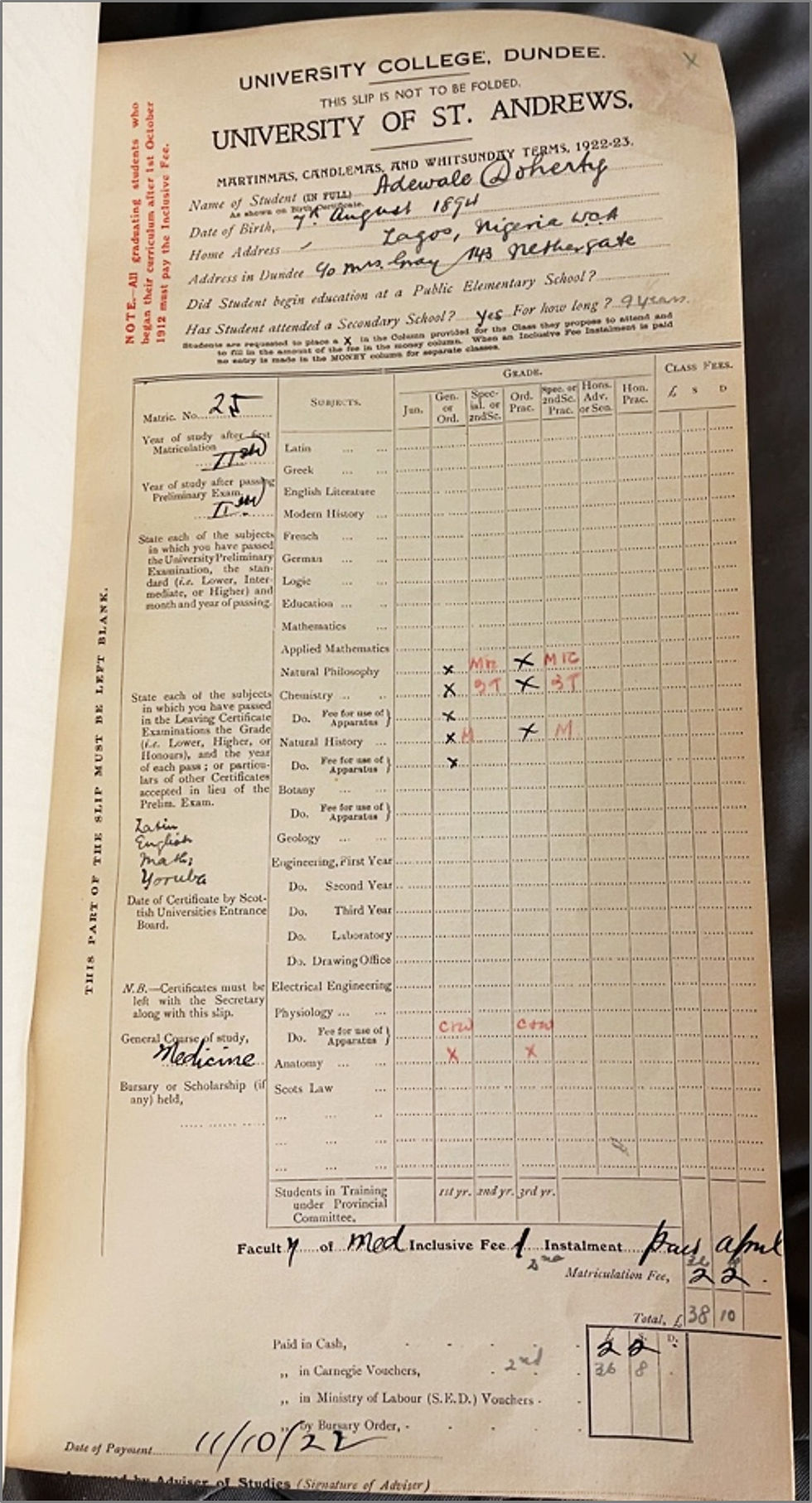
One of the challenges with researching international students is the difficulty of tracing them in records, as unfortunately their names are frequently misspelt. This made my search through newspaper archives for Adewale challenging, however, I was able to find a record in The Scotsman in 1934 stating that Adewale had changed his name from ‘Adewale Doherty’ to ‘Adedeji Adewale’. The reason for this name change was not listed, but in Yoruba ‘Adedeji’ means ‘the crown has become two’ and so perhaps Adewale changed his name to re-enforce his connection to his Nigerian identity. I found a record of death from 1935 for ‘Adedeje Adewale Doherty’, which listed him as being a physician in Edinburgh, indicating that Adewale had qualified as a doctor and (unusually) remained practising within Scotland.
The two other international students I will discuss are Ari Krishna Rama Chandra (1896-?) and Veera Krishna Samy (1899-1974), who were both from Singapore. Rama Chandra (sometimes spelled Ramachandra) was born on 11 July 1896 and he matriculated in 1921 into University College Dundee when he was 25 years old to study medicine. Although from Singapore, his family were Indian, and as a student he seems to have had close ties to the local Indian community. In 1923 he led an ‘Indian Service’ in Ross Street Unitarian Church in Glasgow, and in 1924 he gave a lecture in Dundee on ‘The Industrial and Political Situation in India’. In 1925 he was listed as President of the Dundee Hindu Association.
Rama Chandra is not listed in the University Calendars as having graduated, and instead appears within medical registers with the qualification LMSSA, 1928 (a Licentiate in Medicine and Surgery of the Society of Apothecaries). It is interesting to note that Veera Krishna Samy took the same path, receiving his LMSSA in 1927. After obtaining this qualification, Rama Chandra seems to have returned to Singapore and by 1930 he was an Assistant Surgeon at the Tan Tock Sen Hospital.
Veera Krishna Samy was born on 26 July 1899, his father being a well-respected doctor in Singapore. He matriculated into University College Dundee in 1921, aged 22. He and Rama Chandra evidently socialised together, as can be seen from a newspaper report of a masked ball both attended in 1923, Samy dressed as a Pierrot and Rama Chandra as ‘The Sheik of Araby’. Samy also had family connections in India and in a letter to the Evening Telegraph described his “frequent travels between Singapore and India”. However, like Rama Chandra, Samy does not appear to have completed his degree, and instead received his LMSSA in 1927. That same year, he married Charlotte Fairweather (a local newsagent’s daughter) in Dundee, an early example of a mixed-race marriage in the city. Dr Jainti Dass Saggar, the well-known Indian-born GP, was one of the witnesses.

After a time working in India, Samy returned to Singapore in 1930, taking over his father’s medical practice. The Straits Times reported that he brought with him from Scotland “a charming wife and an enthusiasm for golf and tennis”. He was elected a Municipal Commissioner there in 1938, and was described at the time as a former president of the Hindu Association, vice president of the Hindu Advisory Board and a member of the Singapore Social Hygiene Board. His duties as a Commissioner included serving on a special health committee to advise on the provision of hospital facilities for dangerous and infectious diseases in Singapore.
Samy and his wife later returned to Dundee, where he died in 1974. The Dundee Courier reported his estate being worth £33,363. Charlotte survived him by 26 years; she died in 2000 aged 97.
Overall, these three students demonstrate that while some international students returned to their home country, others chose to remain in Scotland, or returned here later in life. What is clear is that all these men went on to have careers within the medical field, showing the utility and opportunities provided by their Scottish education.
Written by University of St Andrews student Libby Mullen with additions by Matthew Jarron
With thanks to the ‘History of the University’ project at the University of St Andrews, run by the School of History and the University Collections team, and directed by Aileen Fyfe and Sarah Rodriguez.
Sources
Manuscripts/ Archival Sources
St Andrews, University Collections, UYUY316, University College Dundee, Adewale Doherty Matriculation Slip.
St Andrews, University Collections, UYUY316, University College Dundee, Ari Krishna Ramachandra Matriculation Slip, 1920.
St Andrews, University Collections, UYUY316, University College Dundee, Verra Krishna Samy Matriculation Slip, 1920.
St Andrews, University Collections, UYUY322, University of St Andrews, Class Lists, 1920-1923
Printed Primary Sources
Colonial Government of the Strait Settlements, Blue Book for the Year 1930 (London, 1931).
Secondary Sources
Lee, J. M., ‘Commonwealth Students in the United Kingdom, 1940-1960: Student Welfare and World Status’, Minerva, 44:1 (2006), pp. 1-24.
Warner, Maureen, ‘Trinidad Yoruba - Notes on Survivals’, Caribbean Quarterly, 17:2 (1971), pp. 40-49.
Internet Sources
'Adedeje Adewale Doherty’, UK, Burial and Cremation Index, 1576-2024, Ancestry Online Database.
‘Ari Krishna Rama Chandra’, UK & Ireland, Medical Directories, 1845-1942, Ancestry Online Database.
Forward 14 July 1923, p. 8.
Dundee Courier 8 November 1923, p. 3.
Dundee Courier 25 November 1924, p. 4.
Evening Telegraph 21 September 1925, p. 2.
The Scotsman 18 August 1934, p. 1.
Singapore Free Press & Mercantile Advertiser 14 May 1930, p. 307.
The Straits Times 4 April 1930, p. 12 & 26 June 1938, p. 18.
The Straits Budget 16 June 1938, p. 4 & 16 July 1940, p. 12.
Dundee Courier 18 April 1975, p. 3.
'1927 SAMY, VEERA KRISHNA', Statutory registers Marriages 282/1/223, Scotland's People Online Database.
Our Histories: the University of St Andrews since 1750, https://our-histories.wp.st-andrews.ac.uk/


Comments